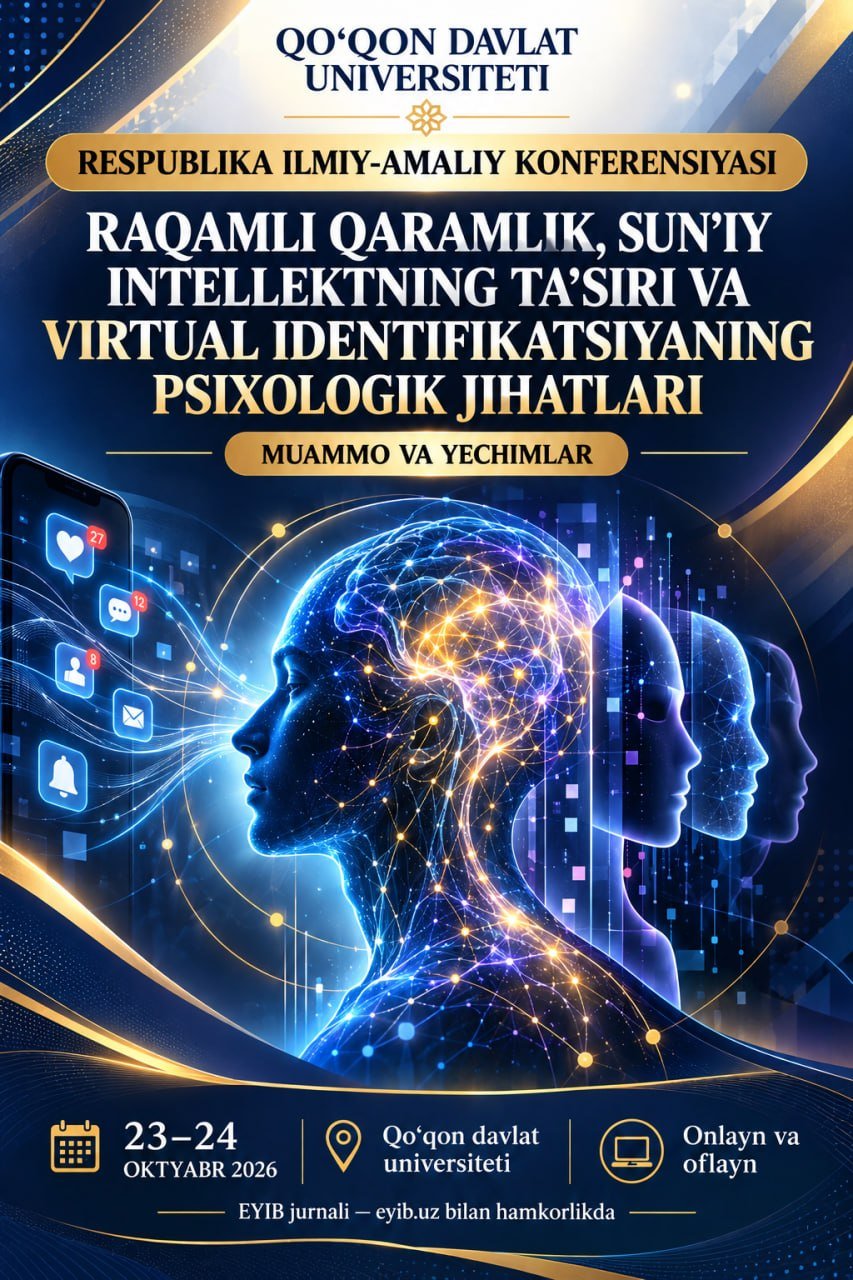
IJTIMOIY TARMOQLAR TA’SIRIDA O‘QUVCHI YOSHLAR DUNYOQARASHI SHAKLLANISHINING O‘ZIGA XOSLIGI (ILK O‘SPIRINLIK DAVRI MISOLIDA)
Abstract
Maqolada ilk o‘spirinlik (15–17 yosh) davrida o‘quvchi yoshlar dunyoqarashi shakllanishining ijtimoiy tarmoqlar va ularda qo‘llaniladigan sun’iy intellekt tizimlari (tavsiya algoritmlari, chatbotlar) ta’siridagi psixologik xususiyatlari yoritilgan. Identifikatsiya, ijtimoiy taqqoslash va algoritmik kontent tushunchalari asosida virtual muhitning shaxs o‘zini anglash jarayoniga ijobiy ta’siri hamda xavfli jihatlari tahlil qilingan, pedagogik-psixologik tavsiyalar berilgan.
Downloads
References
1. O‘zbekiston Respublikasining «Yoshlarga oid davlat siyosati to‘g‘risida»gi Qonuni, 14.09.2016, O‘RQ-406-son.
2. O‘zbekiston Respublikasining «Bolalarni ularning sog‘lig‘iga zarar yetkazuvchi axborotdan himoya qilish to‘g‘risida»gi Qonuni, 08.09.2017, O‘RQ-444-son.
3. Anderson M., Faverio M., Gottfried J. Teens, Social Media and Technology 2023. – Washington: Pew Research Center, 2023.
4. Кон И.С. Психология ранней юности. – М.: Просвещение, 1989.
5. Божович Л.И. Личность и её формирование в детском возрасте. – М.: Просвещение, 1968.
6. Эльконин Д.Б. Избранные психологические труды. – М.: Педагогика, 1989.
7. Erikson E.H. Identity: Youth and Crisis. – New York: W.W. Norton, 1968.
8. Marcia J.E. Development and validation of ego-identity status // Journal of Personality and Social Psychology. – 1966. – Vol. 3, No. 5. – P. 551–558.
9. G‘oziev E.G‘. Ontogenez psixologiyasi. – Toshkent: NIF MSH, 2020.
10. Davletshin M.G., Do‘stmuhamedova Sh., Mavlonov M., To‘ychieva S., Djumabaeva M. Yosh va pedagogik psixologiya: o‘quv qo‘llanma. – Toshkent, 2007.
11. Do‘stmuhamedova Sh.A., Tillashayxova X.A., Baykunusova G., Ziyavitdinova G. Umumiy psixologiya. 2-kitob: Yosh davrlari va pedagogik psixologiya. – Toshkent: Nizomiy nomidagi TDPU, 2020.
12. Boyd D.M., Ellison N.B. Social network sites: Definition, history, and scholarship // Journal of Computer-Mediated Communication. – 2007. – Vol. 13, No. 1. – P. 210–230.
13. Zhao S., Grasmuck S., Martin J. Identity construction on Facebook: Digital empowerment in anchored relationships // Computers in Human Behavior. – 2008. – Vol. 24, No. 5. – P. 1816–1836.
14. Subrahmanyam K., Greenfield P. Online communication and adolescent relationships // The Future of Children. – 2008. – Vol. 18, No. 1. – P. 119–146.
15. Valkenburg P.M., Peter J. Online communication among adolescents: An integrated model of its attraction, opportunities, and risks // Journal of Adolescent Health. – 2011. – Vol. 48, No. 2. – P. 121–127.
16. Turkle S. Alone Together: Why We Expect More from Technology and Less from Each Other. – New York: Basic Books, 2011.
17. Солдатова Г.У. Цифровая социализация в культурно-исторической парадигме: изменяющийся ребёнок в изменяющемся мире // Социальная психология и общество. – 2018. – Т. 9, № 3. – С. 71–80. DOI: 10.17759/sps.2018090308.
18. Pariser E. The Filter Bubble: What the Internet Is Hiding from You. – New York: Penguin Press, 2011.
19. Common Sense Media. Talk, Trust, and Trade-Offs: How and Why Teens Use AI Companions. – San Francisco: Common Sense Media, 2025.
20. Festinger L. A theory of social comparison processes // Human Relations. – 1954. – Vol. 7, No. 2. – P. 117–140.
21. Orben A., Przybylski A.K. The association between adolescent well-being and digital technology use // Nature Human Behaviour. – 2019. – Vol. 3. – P. 173–182.
22. Twenge J.M., Campbell W.K. Associations between screen time and lower psychological well-being among children and adolescents: Evidence from a population-based study // Preventive Medicine Reports. – 2018. – Vol. 12. – P. 271–283.